Staking Tall Flowers: Supports That Keep Stems Upright
Stop tall and heavy-headed flowers from flopping: how to grow sturdier plants, which support suits which plant shape, and how to set stakes, hoops and twine early so they stay hidden.
At a glance
What you need
- Bamboo canes or slim stakes
- Soft garden twine or cloth ties
- Hoops or grow-through grids
- Twiggy branch prunings
- Hand pruners
- Mallet for firm ground
A summer storm passes and the best plants in the bed are lying flat: spires snapped, heavy blooms face down in the mud. Propping them up afterward rarely looks right, because bent stems do not straighten and a bundle tied to a post looks like a rescue.
Staking tall flowers works when it is done early and quietly, with the right kind of support for the shape of the plant. It also helps to reduce how much support plants need in the first place.
Which plants tend to need support
Three groups flop most often:
- Tall spires. Delphiniums, foxgloves and hollyhocks carry a lot of flower on one tall stem that catches the wind.
- Heavy double flowers. Peonies, tall dahlias and large African marigolds have blooms that fill with rain and pull the stems over.
- Lanky clumps. Many perennials grow soft and tall in rich soil, in windy spots or in part shade, where they lean toward the light.
These plants are examples of shapes, not a planting list. Whether any of them suits your garden depends on your climate and hardiness zone, so check the tag. Mature heights are ranges that vary by variety and growing conditions.
Prevention comes first
Sturdy plants need less hardware. Before buying supports, look at the causes of weak growth:
- Enough sun. A plant that wants full sun grows stretched and floppy in shade.
- Restrained feeding. Heavy feeding, especially in soil that is already rich, produces tall, soft stems. Feed according to a soil test and the product label.
- Correct spacing. Crowded plants stretch upward and lean on each other. See the guide to spacing flowers correctly.
- Compact varieties. Many tall flowers come in shorter varieties bred to stand without help.
- Shelter. A fence or hedge on the windward side reduces buffeting.
Cut back late bloomers for sturdier growth
Certain perennials that flower in late summer or fall can be cut back by a third to a half in late spring to early summer. They respond by branching, which gives shorter, bushier plants with more, slightly smaller flowers a little later than usual. The technique is often called the Chelsea chop.
It suits plants that branch freely, such as asters, tall sedum, garden phlox and bee balm. Do not use it on plants that send up a single flower stalk, such as delphiniums, foxgloves, peonies or daylilies, because removing that stalk removes the season’s flowers.
Good to know
The right moment for cutting back depends on your climate. The usual guide is when plants are growing strongly but have not yet formed flower buds. Where the growing season is short, cut early and lightly so plants still have time to bloom before the first fall frost. If you are unsure, cut back only half the stems of a clump and compare.
Choose the support for the plant’s shape
| Support | Best for | How it works |
|---|---|---|
| Single stake and ties | Tall spires and single heavy stems | One stake per stem, tied at intervals |
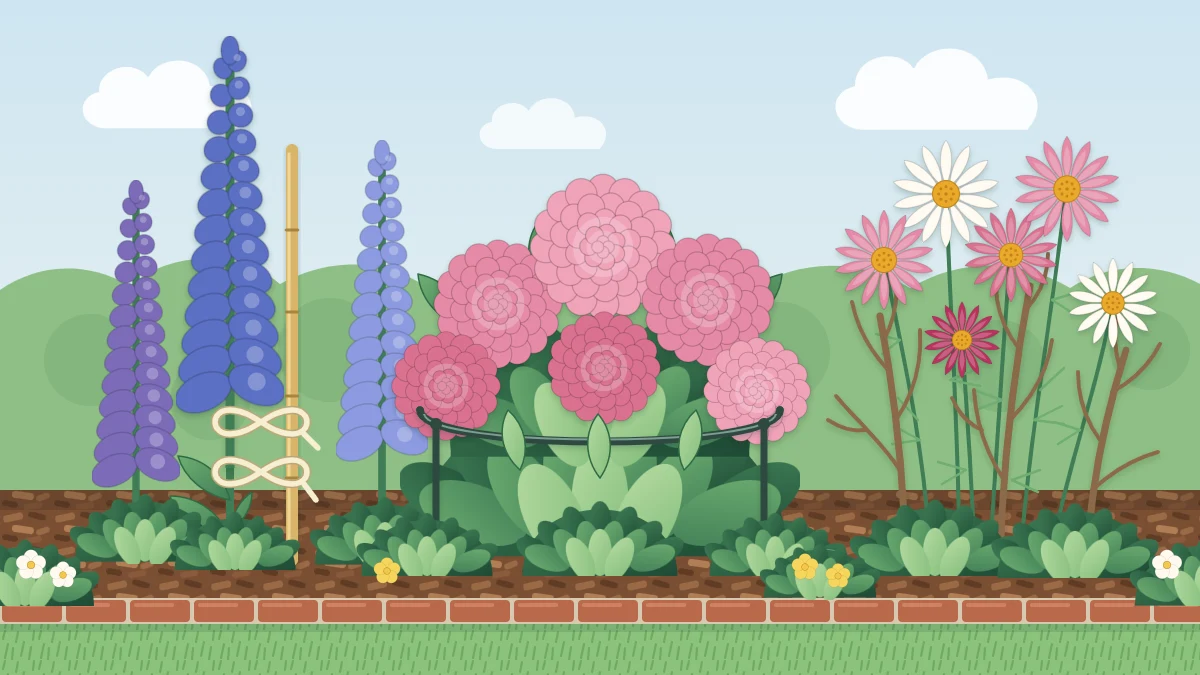
| Hoop or grow-through grid | Bushy clumps such as peonies | A ring or mesh on legs that stems grow up through |
| Twiggy branches | Fine-stemmed clumps and annuals | Branched prunings pushed in around the plant |
| Stakes and twine corral | Large groups and whole drifts | Twine run around and across several stakes |
How to put each support in
Single stakes
- Push a bamboo cane or slim stake firmly into the ground 2 to 3 in (5 to 8 cm) from the stem, behind it as seen from the front of the bed. Take care not to spear the crown, bulbs or tubers.
- Tie the stem with soft twine or a strip of cloth in a loose figure eight: one loop around the stake, a crossover, one loop around the stem. The crossover cushions the stem and lets it move a little.
- Add more ties as the stem grows, roughly every 12 in (30 cm).
Hoops and grids
Set the hoop or grid over the clump while shoots are only a few inches tall and push the legs in firmly. Stems grow up through the openings and leaves soon cover the frame. Raise adjustable types as the plant grows.
Twiggy branches
Push branched prunings, often called pea sticks, into the soil around and among the young shoots, with the twiggy tops a little below the plant’s expected height. Growth weaves through and hides them. It is the most natural-looking option and costs nothing if you have shrubs to prune.
Stakes and twine
For a group, set four or more stakes around the outside, then run twine from stake to stake around the perimeter and diagonally across the middle. Add a second tier higher up as plants grow.
Timing and height: the two rules that matter
Put supports in early. The best moment is while plants are short, soon after growth starts for the season. They then grow up through and around the support and hide it, and you avoid damaging roots and stems later. A good prompt is to add them during your routine spring flower garden tasks. For more on timing, see the perennial maintenance guide from Iowa State University Extension and Outreach.
Stake to about two thirds of the final height. A support that stops below the flowers holds the stem where it needs holding and disappears into the foliage. For a spire expected to reach 6 ft (1.8 m), that means roughly 4 ft (1.2 m) of stake above the ground. Very heavy flower heads sometimes need a tie just below the bloom as well.
Check, adjust and store
Look over supports every couple of weeks in the growing season. Stems thicken, and a tie that was loose in spring can cut in by midsummer, so loosen or replace any that are tight. Tuck stray stems back inside hoops and add twine where a clump has outgrown its corral.
If a plant has already gone over, support it gently where it lies instead of forcing it upright, and plan a proper support for next season.
At the end of the season, pull out stakes, hoops and twine, brush off the soil and store them dry. On your garden plan, note which plants needed help. Placing tall plants toward the back, where neighbors help prop them, is part of planning a layered flower border.
Frequently asked questions
When should I stake tall flowers?
Early in the growing season, while plants are still short and before they start to lean. Stems then grow up through or alongside the support and the leaves hide it. Staking after a plant has flopped is difficult, because bent stems rarely straighten and it is easy to damage roots and shoots.
How tall should a plant stake be?
Aim for about two thirds of the plant's expected final height above the ground, plus enough length to push firmly into the soil. A stake that stops below the flowers stays out of sight. Use the mature height on the plant tag as your guide, since heights vary by variety and conditions.
Can I avoid staking altogether?
Often you can reduce it. Give plants the sun they need, avoid overfeeding, space them properly and choose compact varieties. Some late-flowering perennials that branch freely can also be cut back before buds form so they grow shorter and bushier. Very tall spires and heavy double flowers usually still need support.