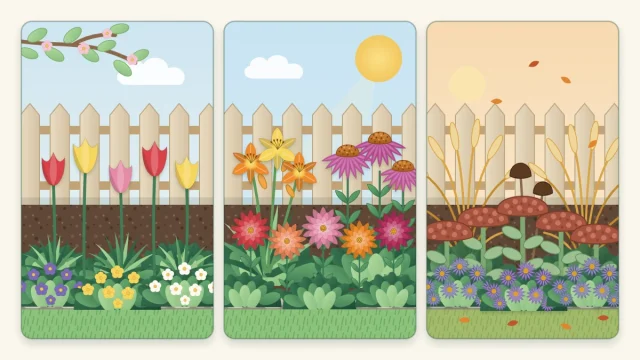
How to Plan a Flower Border: Height, Layers and Edges
Plan a long bed along a fence, wall or path: how deep to make it, how to layer plants by mature height, how to group and repeat them, and which edge keeps the lawn out.

A flower border is a long planting bed that runs beside something: a fence, a wall, a hedge, a path or the edge of a lawn. You usually see it from one side and walk along its length, so it behaves differently from a round island bed, and a little planning on paper saves a lot of digging up later.
Three decisions do most of the work: how deep the border is, how the plants are layered by height, and how the front edge is finished. Get those right and even a short plant list looks deliberate.
Decide how deep the border should be
A thin strip 1 to 2 ft (30 to 60 cm) deep only has room for a single row of plants, which tends to look like a queue. A border deep enough for three layers reads far better. In many home gardens that means roughly 4 to 6 ft (1.2 to 1.8 m) from front to back, but any depth works if you match the number of layers to it.
Reach matters too. Most people can tend about 2 to 3 ft (60 to 90 cm) into a bed from the edge without stepping on the soil. If the border is deeper than that and backed by a fence or wall, leave a narrow maintenance path at the back, just wide enough to stand on. A row of stepping stones or a strip of mulch is enough. Plants hide it by midseason, and you can weed, tie and cut back without trampling anything.
Layer plants by mature height
The classic arrangement puts plants in three bands so that every one of them can be seen and gets its share of light:
- Back: tall plants, such as delphiniums, hollyhocks, sunflowers or tall ornamental grasses.
- Middle: medium plants, such as coneflowers, daylilies, salvia or zinnias.
- Front: low mounding and spilling plants, such as catmint, sweet alyssum or compact marigolds.
In an island bed seen from all sides, the tallest plants go in the middle instead and the layers step down toward every edge.
Mature heights are ranges, not fixed numbers. A dwarf and a tall variety of the same flower can differ by several feet, and most plants grow taller in rich soil, in a long warm season or when they stretch toward light in part shade. Use the height printed on the tag of the specific variety you are buying.
Good to know
The plants named here are examples of height and shape, not a list for every climate. A perennial only returns where it is hardy, so check the hardiness zone range on the tag against your own zone, and remember that summer heat and humidity matter as well as winter cold. Annuals are either warm-season and frost tender or cool-season, which decides when they can fill their place in the border.
Break up the staircase
Followed too strictly, the three bands look like bleachers. Soften them:
- Pull a few tall, airy plants forward into the middle band. Slim stems with small flowers work as a veil you look through.
- Let a medium group run right down to the front edge in one or two places.
- Vary the depth of each band along the length so the lines between layers wander.
Plant in drifts and repeat them
One of everything looks spotty in a long bed. Set the same plant in a drift, which is a group of three, five or seven, and shape each drift as a stretched teardrop that slides between its neighbors instead of a neat circle. Odd numbers are easier to arrange without forming rows.
Then repeat. The same drift appearing three or four times along the border gives the eye a rhythm to follow and ties the length together. Keeping to a limited palette helps as well, and the guide to choosing a color scheme for your flowers shows how to pick one.
Inside each drift, set plants at the distance their mature spread calls for. The article on how far apart to plant flowers explains how to read the spacing on a tag.
Use the backdrop and add structure
A fence, hedge or wall is half the picture. A plain, dark background makes flower colors stand out, while a busy one competes with them. Each backdrop also changes growing conditions:
- A wall or solid fence casts shade on one side and reflects heat on the other. In the Northern Hemisphere, the south-facing side is the warm, bright one.
- A hedge takes water and nutrients from nearby soil, so leave a gap between its base and your back row.
- Eaves and walls can keep rain off the strip of soil right beside them.
Add a few structure plants as well: small shrubs, ornamental grasses or sturdy perennials with good foliage, repeated at intervals. They hold the border’s shape while flowers come and go.
Choose an edge that keeps the lawn out
A clear edge stops grass creeping into the bed and makes mowing quicker. Common options:
| Edge | What it is | Upkeep |
|---|---|---|
| Spade-cut edge | A shallow V-shaped trench cut between lawn and bed | Costs nothing; needs recutting a few times each season |
| Brick | Bricks laid flat, level with the lawn | A mower wheel can run along it; occasional weeding of joints |
| Stone | Flat stones or cut blocks set into the soil | Long-lasting; grass can creep through gaps |
| Metal strip | A thin band pushed into the ground | Nearly invisible; holds a crisp line with little work |
Curves or straight lines?
Straight borders suit formal gardens, narrow yards and beds that follow a path or fence. They are the simplest to lay out and mow beside.
Curves feel relaxed, but they need to be long and generous. Tight wiggles look fussy and are awkward to mow. Lay a garden hose or a rope on the ground, adjust it until the sweep looks right from the house, and check that a mower can follow it before you cut the edge.
Leave room to grow and plan supports early
A newly planted border looks sparse. Many perennials take two or three seasons to reach their full spread, so resist filling every gap with more of them. Annuals make good temporary fillers while the permanent plants bulk up.
Finally, mark on your plan which back-row plants are likely to need holding up. Supports work best when they go in while plants are still short, so decide now where they will stand. The guide to supporting tall flowers covers the options.
Frequently asked questions
How deep should a flower border be?
Deep enough for the number of layers you want. A strip a foot or two deep holds one row of plants, while roughly 4 to 6 feet from front to back gives room for tall, medium and low layers. If you cannot reach the back from the lawn, add a narrow path behind the plants.
Do tall plants always have to go at the back?
Mostly, so they do not hide shorter plants, but a strict back-to-front slope looks stiff. Bring a few tall plants with slim stems and small flowers forward so you look through them, and let some medium plants reach the front edge. In an island bed, the tallest plants go in the middle.
How many different plants should a border have?
Fewer than most beginners expect. A handful of plants set in groups of three, five or seven and repeated along the length usually looks more settled than a long list planted one of each. Choose kinds that suit your light, soil and climate, then add variety slowly over the years.