Planning for Continuous Bloom From Spring to Fall
Learn how to plan a flower bed that has something open from spring to fall: chart what you grow by bloom period, find the gaps, and fill them with plants and simple techniques.
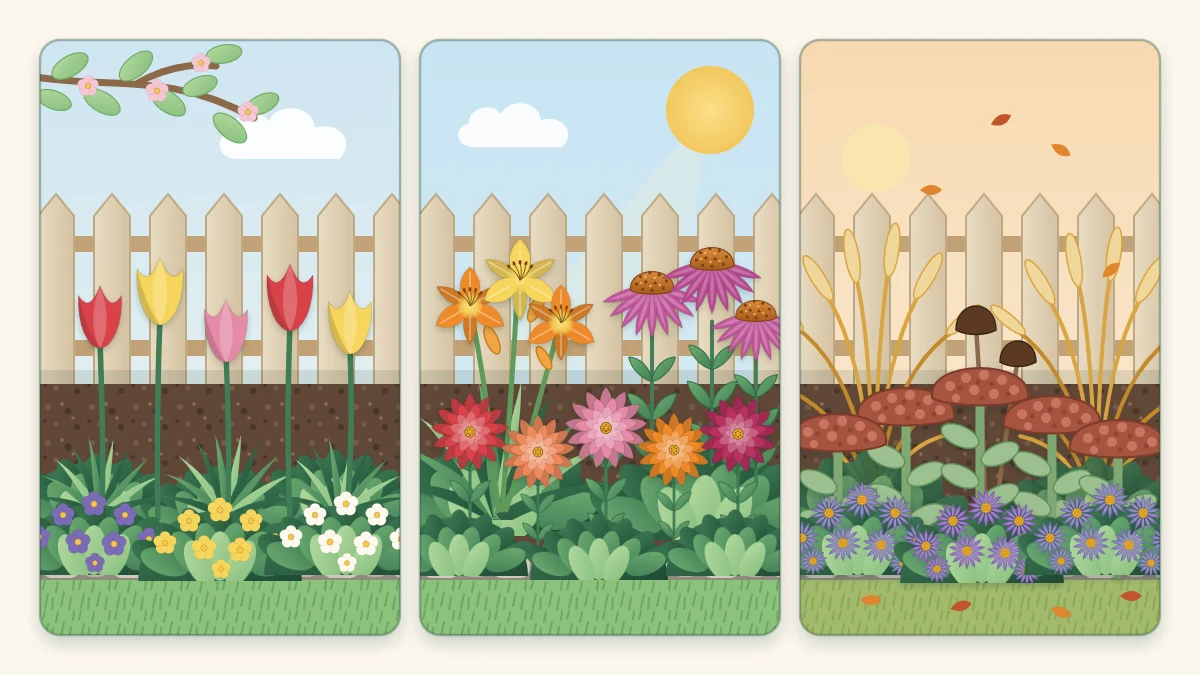
A bed that is glorious for three weeks and plain green for the rest of the season is not a failure of care. It is usually a bed where everything was bought on the same shopping trip, when the same plants were in flower.
Continuous bloom comes from planning in waves: choosing plants whose flowering periods follow one another, and threading long-flowering plants between them so there is always something open. Nothing here needs special skill, only a list, a simple chart and some patience.
Why one wave is never enough
Most perennials flower for a few weeks each year. Some go on longer and a few repeat, but a border of perennials that all peak together will always have a long quiet stretch. Annuals work differently: many flower for months once they start, until frost or heat ends their season. The comparison of annuals and perennials explains that difference in more detail.
So the plan has two parts. Perennials and bulbs supply a sequence of peaks, and annuals supply the steady thread that runs underneath them.
Take stock by bloom period
Start with what you already grow. Write down each plant and when it flowers, using periods instead of calendar months: early spring, late spring, early summer, midsummer, late summer and fall. Bloom time shifts with climate and from one year to the next, so a plant that opens in early summer in a cold-winter region can flower weeks earlier where winters are mild. The order in which plants bloom stays much steadier than the dates.
If you are not sure when something flowers in your garden, note it this year as it happens. A few dated snapshots of the bed through the season make a reliable record.
Draw a simple bloom chart
A bloom chart turns that list into something you can read at a glance.
- Rule a sheet of paper into six columns, one for each period from early spring to fall.
- Write your plants down the left side, one per row.
- Shade the columns in which each plant flowers, ideally in a pencil close to its flower color.
- Read down each column. A column with little or no shading is a gap.
Columns crowded with shading show where you could remove or swap a plant; empty ones tell you what to shop for. Colored columns also show which flowers will actually be open together, which is what matters for color combinations.
The building blocks of a long season
Each period has its own typical plants. Treat the examples below as starting points to check against your own conditions.
| Period | Typical sources of bloom | Notes |
|---|---|---|
| Spring | Spring bulbs such as daffodils and tulips, early perennials, cool-season annuals such as pansies | Many spring bulbs need a cold winter; cool-season annuals fade as heat arrives |
| Early summer | Peonies, catmint, salvia, bearded iris | Often the easiest peak to achieve |
| High summer | Coneflowers, daylilies, black-eyed Susans, and warm-season annuals such as zinnias and marigolds | Warm-season annuals are frost tender and carry on until frost |
| Late season | Asters, tall sedum, ornamental grasses | The period beginners most often leave empty |
Good to know
A perennial only returns where it is hardy, and some that survive cold winters struggle with heat and humidity at the warm end of their range. Check the hardiness zone range on the tag of the specific variety against your own zone. In mild-winter and hot-summer climates the seasons run differently: the cool months can be the main flowering season and midsummer the quiet one.
If you need candidates for the middle of the chart, the list of dependable perennials for beginners gives bloom seasons and commonly cited zone ranges.
Fill the gaps without overfilling the bed
Add plants for your emptiest column first. Late summer and fall are the usual weak spots, because gardens are planted in spring, when late bloomers are small green clumps that nobody notices on the bench.
Two habits keep the bed from turning into a jumble:
- Spread each period’s plants along the whole bed instead of bunching them at one end, so every part has something in flower in every period.
- Pair early and late plants as neighbors. Late risers and annuals can grow up to hide the fading leaves of spring bulbs, which should be left to yellow naturally.
Let foliage and seed heads carry the lulls
Even a well-planned bed has days between waves. Leaves, shapes and seed heads carry it through:
- Foliage with presence, such as broad, silvery, grassy or finely cut leaves, looks good for the whole growing season.
- Ornamental grasses add height and movement long before and after they flower.
- Seed heads of plants such as coneflowers and sedum stay handsome into fall and winter.
A mix of flower shapes and leaf textures makes a bed read as planted and intentional even on a week with few open flowers.
Stretch the bloom you already have
Four techniques add weeks without adding plants:
- Deadheading. Removing spent flowers keeps many annuals and some perennials producing. See the guide to removing faded flowers for which plants respond.
- Cutting back after the first flush. Certain perennials, including catmint and many salvias, often flower again if sheared by about a third once the first show fades.
- Succession sowing. Sow quick annuals in two or three batches a few weeks apart instead of all at once, where your warm season is long enough for the later sowings to mature.
- Mixing varieties. Early, midseason and late varieties of the same plant, such as daylilies or tulips, extend one flower’s season in the same spot.
Not every plant responds to cutting. Some flower once whatever you do, so look up each one before you reach for the shears.
Learn what blooms when where you live
Books and tags give general bloom seasons, but local observation is better. Visit public gardens, nurseries and neighborhood front yards at several points in the season and note what is flowering, especially in the periods your chart shows as empty. Plants bought in flower late in the season are an easy way to fill a late gap, because you can see exactly what you are getting.
Expect to adjust for two or three years. Update the chart each season, move or replace what did not earn its place, and the quiet stretches will shrink.
Frequently asked questions
Can a garden of only perennials flower all season?
It can come close if you choose perennials with different bloom periods and include late-season plants, but there will usually be short lulls because most perennials flower for only a few weeks. Adding long-flowering annuals, or relying on foliage and seed heads between waves, covers those quieter stretches.
Why do flower beds often look bare in late summer?
Often because most plants were bought in spring, when spring and early summer bloomers look their best and late bloomers are just green clumps. Chart what you grow by bloom period, then add plants for late summer and fall, such as asters, tall sedum and ornamental grasses, if they suit your climate.
How do I find out when plants bloom in my area?
Watch local gardens. Bloom times shift with climate and from year to year, so general guides only give the order. Visit nurseries, public gardens and nearby yards several times through the season, note what is flowering, and keep a simple record of your own bed as each plant opens.