Flower Spacing: How Far Apart to Plant Flowers
Understand what the spacing on a plant tag means, why crowding causes problems later, and how variety, climate and soil change the right distance between flowers.

A newly planted bed always looks sparse. The plants are small, the soil between them is bare, and the temptation is to squeeze in a few more so everything looks full by the weekend. Good flower spacing asks you to plant for the size the plants will be, not the size they are today.
That does not mean following one chart. The right distance depends on the variety, your climate, your soil and the look you want, so this guide explains how to read the number on the tag and when it makes sense to bend it.
What the spacing on the tag means
The spacing printed on a plant tag or seed packet is measured center to center: from the main stem of one plant to the main stem of the next. It is not the gap you leave between the edges of the leaves.
That figure usually reflects the mature spread of the plant. A tag that says “space 12 in (30 cm) apart” is telling you that each plant will fill a circle about that wide once it has grown, so that neighbors just touch and cover the soil without smothering each other.
Why spacing matters
Plants set too close can look wonderful for a few weeks and then struggle. Giving each one room pays off in several ways:
- Air movement. Leaves dry faster after rain or dew, and many leaf diseases, such as powdery mildew, are more common where foliage stays damp and crowded.
- Less competition. Each plant has its own share of water, nutrients and light, so the planting is less likely to wilt as a group in dry weather.
- Sturdier stems. Crowded plants stretch upward toward the light, which often leaves them tall, thin and likely to flop.
- Room to work. You can reach in to weed, deadhead and water at the base.
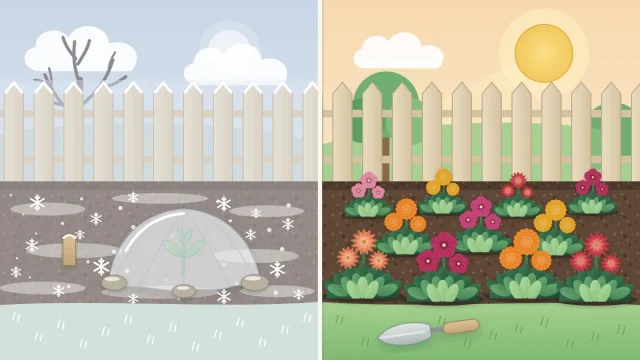
Planting too far apart has a cost as well: bare soil that dries out, invites weeds and looks unfinished. The aim is foliage that meets when the plants are full grown.
Typical ranges by plant size
The figures below are broad ranges to help you picture a planting. They are not a substitute for the tag, because two varieties of the same flower can differ widely.
| Plant size | Typical spacing range | Check on the tag |
|---|---|---|
| Low edging plants and small annuals | 6 to 10 in (15 to 25 cm) | Whether the variety mounds or trails |
| Medium bedding annuals and compact perennials | 10 to 18 in (25 to 45 cm) | Mature spread, not only height |
| Large perennials and tall annuals | 18 to 36 in (45 to 90 cm) | Spread after several years for perennials |
What changes the right distance
The variety
A dwarf zinnia and a tall cutting zinnia are both zinnias, yet one may want less than half the room of the other. Always go by the named variety you bought.
Your climate and season length
Plants generally grow larger where the growing season is long and warm, and stay smaller where it is short and cool. If you garden in a short-season climate, the closer end of the range on the tag often works; in a long, warm season, the wider end is usually wiser. In humid climates, extra room for air matters more.
Your soil
In rich, moist soil plants reach or exceed their listed spread. In lean, dry soil they tend to stay more compact.
The look you want
A formal edging reads best as a continuous ribbon, so the plants sit at the close end of their range. A loose cottage-style planting can be more generous, letting each plant show its natural shape.
Spacing two different plants
Tags tell you how far to set a plant from another of the same kind. When neighbors have different spreads, a handy rule of thumb is to use roughly the average of the two. If one plant spreads about 12 in and its neighbor about 24 in (60 cm), set their centers about 18 in apart.
Staggered rows, triangles and drifts
Straight rows in a grid leave square gaps and look stiff. Setting plants in staggered rows, so that each plant in the second row sits opposite a gap in the first, forms triangles. Every plant is then the same distance from all its neighbors, the soil is covered more evenly and the planting looks natural sooner.
For a relaxed look, group plants of one kind in a drift of three, five or seven instead of dotting single plants around. Odd numbers are harder for the eye to split into pairs, so the group reads as one sweep of color. Our guide to planning a flower border shows how to arrange those drifts by height.
Tip
Before you dig, set every plant out on the bed in its pot and step back. It is far easier to shuffle pots than to replant. A stick cut to your spacing distance makes a quick measuring tool.
Annuals, perennials and temporary fillers
Annuals live for one season, so there is no future size to allow for. You can set them a little closer than their mature spread for a fuller look sooner, as long as you accept that they will need more water and that air will move less freely.
Perennials are different. A young perennial in a small pot may take two or three years to reach full size, so space it for year three, not for this summer. The bed will look thin at first. Fill the gaps with annuals for the first season or two and stop adding them as the perennials close in. When an older clump eventually outgrows its space, dividing the perennial restores the room.
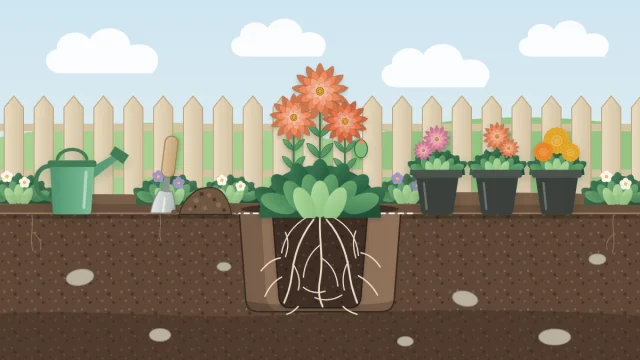
Whatever you plant, the planting itself matters as much as the distance. The step-by-step method is in our guide on how to plant flowers.
Seedlings and containers
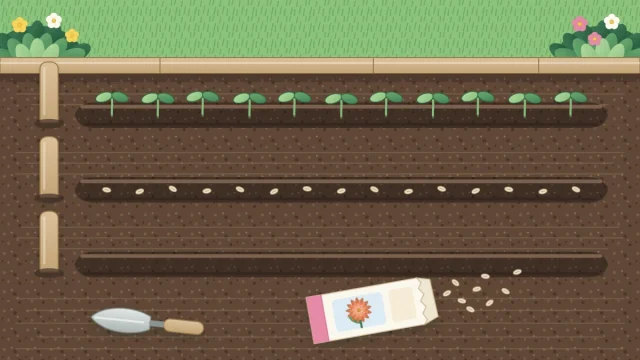
Flowers sown directly in the garden almost always come up too thick. Once the seedlings have their first true leaves, thin them to the spacing on the packet by snipping the extras at soil level, which avoids disturbing the roots of the ones you keep. It feels wasteful, but a row left unthinned gives many weak plants instead of a few strong ones.
Containers are the exception to all of this. Pots are planted more closely on purpose, because you want them full from the start and you supply the water and feeding that crowded roots need. Expect to check a tightly planted pot for water far more often than a bed.
Frequently asked questions
What happens if I plant flowers too close together?
They often look full at first, then compete for water and light. Crowded plants tend to grow tall and weak, dry out faster as a group, and stay damp after rain, which makes leaf diseases more likely. With annuals you can thin out a few plants; with perennials you may need to lift and move some.
Is spacing measured from the edge of the plant or the center?
From the center. The figure on a tag or packet is the distance from the main stem of one plant to the main stem of the next. Measuring from leaf edge to leaf edge would put plants much farther apart than intended and leave gaps once they are full grown.
Can I plant annuals closer than the tag says?
A little closer is fine if you want quick fullness, since annuals only need to fit for one season. Do not halve the distance. Tightly planted annuals need more attentive watering and have less air moving through them, so in humid climates it is wiser to stay near the recommended spacing.