When to Plant Flowers: Frost Dates, Soil and Your Climate
No single planting date fits every garden. Learn how to use your local frost dates, soil temperature and the type of plant to decide when flowers can go in the ground where you live.
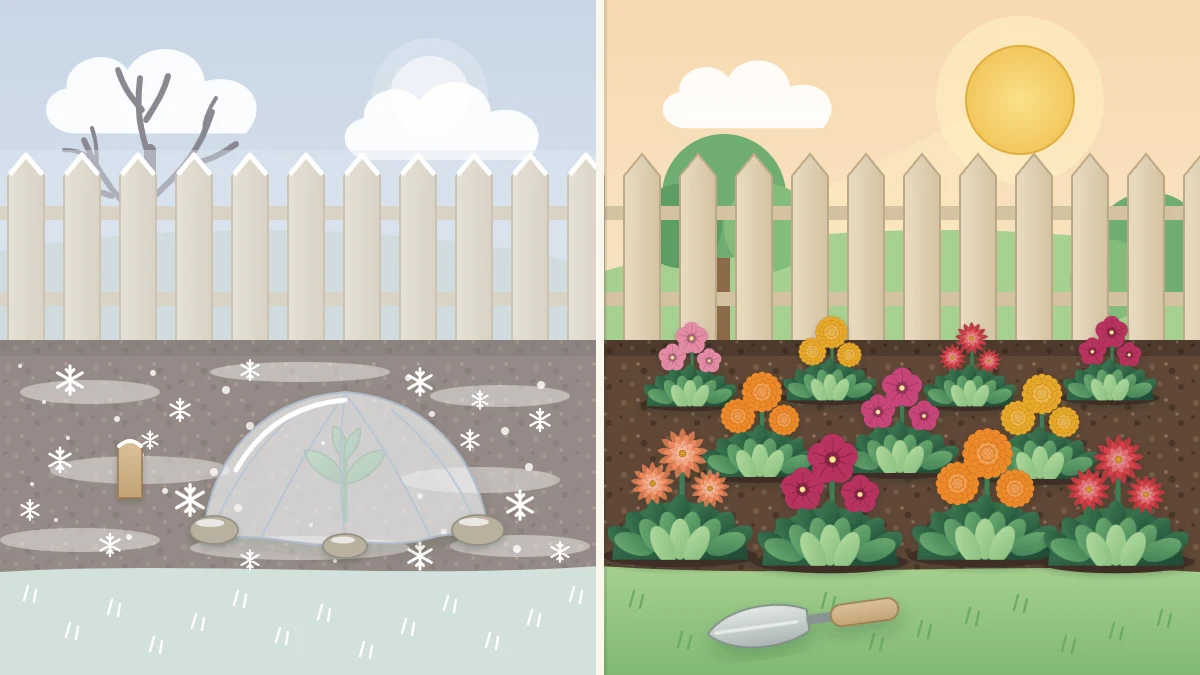
If you are asking when to plant flowers, you are probably hoping for a date. The honest answer is that no single date exists, because a gardener in a cold-winter region and one in a mild-winter climate are living through different seasons in the same week.
What you can have instead is a short set of local clues: your frost dates, the temperature of your soil and the kind of plant in your hand. Put those three together and the right moment for your own garden becomes fairly easy to read.
Why there is no single planting calendar
Planting advice pinned to a calendar was written for one place. Move a few hundred miles (several hundred kilometers), climb a hillside or drop into a valley, and the same advice can be weeks early or weeks late. Even inside one town, a sheltered courtyard warms sooner than an open, low-lying yard where cold air settles.
So treat every timing tip, including the ones here, as a pattern tied to conditions. “After your last spring frost” travels well from garden to garden. A date on a wall chart does not.
Start with your frost dates
In any climate that gets frost, two dates frame the growing season:
- Your average last frost date in spring. Tender plants go outside after it.
- Your average first frost date in fall. It marks the likely end of the season for tender plants and helps you time fall planting.
Look both up for your exact location through your local extension service or national weather service rather than borrowing a date from a friend in another county. For a clear explanation of how to read a frost-probability chart, see University of Maryland Extension; its dates are for Maryland, but the method applies wherever frost occurs.
Frost dates are averages, not promises. Frost still arrives after the average date in a good share of years, which is why many gardeners wait a week or two beyond it before setting out anything tender.
Good to know
A hardiness zone and a frost date answer different questions. The zone describes how cold your winters get, which tells you whether a perennial is likely to survive them. It does not tell you when to plant. Our guide to how plant hardiness zones work covers that side, including the systems used outside the United States.
Check the soil temperature, not just the air
Soil warms more slowly than air. A run of sunny afternoons can feel like planting weather while the ground a few inches (several centimeters) down is still cold. In cold, wet soil, seeds may rot before they sprout and transplants tend to sit without growing.
An inexpensive soil thermometer removes the guesswork. Push it in to planting depth in the morning for a few days in a row. As a rough guide, many warm-season flowers sprout and root readily once the soil stays in the 60s °F (roughly 16 to 20°C) or warmer, while cool-season kinds get going in cooler ground. Seed packets often give a figure for the variety.
Match the timing to the plant type
Once you know your frost dates and soil temperature, the plant itself tells you the rest.
| Plant type | What it tolerates | General timing |
|---|---|---|
| Tender, warm-season annuals such as zinnias, marigolds and impatiens | No frost; they sulk in cold soil | After the danger of frost has passed and the soil has warmed |
| Hardy, cool-season annuals such as pansies and sweet alyssum | Cool weather and, once hardened off, light frost | Earlier, while the weather is still cool; through fall and winter in mild-winter climates |
| Perennials that are hardy in your zone | Cool conditions | Spring once the soil is workable, or early fall with time to root |
| Tender perennials grown as annuals | No frost | The same as tender annuals |
Transplants raised in a greenhouse or on a windowsill need hardening off first: about a week of gradually longer spells outdoors, so that sun, wind and cool nights do not shock them.
If your summers are hot or your winters are mild
Much planting advice assumes a cold winter followed by a gentle summer. If you garden where frost is rare or summers are long and fierce, the pattern shifts. Fall and winter are often the main planting seasons, and cool-season flowers are grown through the winter months rather than in spring.
In these climates the limit is usually heat, not frost. Perennials and shrubs planted as the weather cools have months to root before the next hot spell, while anything planted just ahead of summer needs close attention to water and shade. Your local extension service can tell you how the planting seasons run in your area. In the Southern Hemisphere, the seasons fall in the opposite half of the year.
Fall planting of perennials
Early fall suits many perennials: the soil is still warm, the air is cooler and rain is often more dependable. The one condition is time. Roots need several weeks to grow into the surrounding soil before the ground freezes, so the colder your winters, the earlier your fall planting window closes.
Read the seed packet and plant tag
Packets and tags speak in frost dates, which is exactly why those dates are worth knowing.
- “Sow after last frost” means a tender plant that also wants warm soil.
- “Start indoors 6 to 8 weeks before last frost” means counting back that many weeks from your own average date.
- “Sow as soon as the soil can be worked” points to a hardy kind that prefers a cool start.
- Days to bloom lets you check that a late sowing can still flower before your first fall frost.
If you plan to skip transplants altogether, the steps for sowing flower seeds straight into the garden follow the same timing rules.
Watch the forecast and keep covers handy
Before you set out tender plants, look at the forecast for the week or two ahead instead of relying on the average alone. If a clear, still, cold night threatens after planting, cover young plants in the evening with an old sheet, frost cloth or upturned pots, and uncover them the next morning once it warms up.
When in doubt with tender flowers, a little late is kinder than a little early: a plant set out into warm soil often catches up with one that shivered for two weeks. For everything else that needs doing as the season opens, work through the spring flower garden checklist.
Frequently asked questions
Is it safe to plant flowers right after my last frost date?
Not always. The date is an average, so frost can still arrive after it in some years. For tender annuals, many gardeners wait a week or two longer, check that the soil has warmed and watch the forecast. Hardy annuals and perennials that tolerate cool weather can usually go in sooner.
How do I find my frost dates?
Search for your average last spring frost and first fall frost by location through your local extension service or national weather service. Use the figure for your own town, not a neighboring region, and remember that low spots and exposed sites in the same area can run colder than the listed average.
Can I plant flowers in summer?
You can, but it is the hardest season for new plants in most climates because heat dries the root ball quickly. Plant on a cool, cloudy day or in the evening, water the root zone thoroughly, mulch, and check the soil often until new growth shows the plant has rooted.