How to Sow Flower Seeds Outdoors
A step-by-step guide to direct sowing: which flowers suit it, how to time it by frost dates, how to prepare a seedbed, sow at the right depth, keep it moist and thin the seedlings.
At a glance
What you need
- Flower seed packets
- Garden rake
- Hand fork or trowel
- Stick or hoe for furrows
- Plant markers and pencil
- Watering can with a fine rose
- Small scissors for thinning
A packet of seed costs less than a single potted plant and can fill a whole bed. When you sow flower seeds outdoors, right where the plants will bloom, you also skip the trays, lights and potting up that indoor seed starting involves.
Direct sowing is simple, but it rewards care at three points: choosing flowers that suit it, waiting for the right conditions, and looking after the seedbed for the first couple of weeks.
Which flowers suit direct sowing
The best candidates are quick-growing annuals, especially those with seeds large enough to handle one at a time. Zinnias, sunflowers, cosmos, nasturtiums and marigolds all sprout readily in warm soil and grow fast enough to flower the same season in most climates.
Some flowers actually prefer it. Sunflowers, nasturtiums and poppies tend to resent having their roots disturbed, so sowing them in place often gives sturdier plants than transplanting does.
Others are poor choices for beginners to sow outside. Petunias, impatiens and wax begonias have dust-fine seed and grow slowly at first, so they are usually started indoors well ahead of the season or bought as transplants.
When to sow
Go by the packet and your local frost dates, not by a calendar. Flower seeds fall into two broad groups:
- Tender, warm-season kinds (zinnias, marigolds, cosmos, sunflowers, nasturtiums) are sown after your last spring frost, once the soil has warmed. Seed sown into cold, wet ground often rots.
- Hardy, cool-season kinds (such as larkspur, bachelor’s buttons and sweet alyssum) can be sown earlier, while the weather is still cool. In mild-winter climates, some of these are sown in fall to bloom in late winter and spring.
If you are unsure how these rules apply where you live, our guide on when to plant flowers in your climate explains frost dates and soil temperature in more detail.
Prepare a fine seedbed
Seeds need close contact with moist soil, and tiny seedlings cannot push past clods or compete with weeds. Choose a spot with the light the packet asks for, which for most easy annuals means full sun.
- Remove every weed, roots included, along with stones and old plant debris.
- Loosen the top several inches of soil with a fork if it is compacted. Work only when the soil is moist and crumbly, never when it is sticky.
- Rake the surface back and forth until it is level and the top inch (2.5 cm) is fine and crumbly.
If the bed is new or the soil is poor, it is worth improving it first. See how to prepare soil for a flower bed before you sow.
How to sow, step by step
- Read the packet. Note the sowing depth, the final spacing and how many days the seed usually takes to sprout.
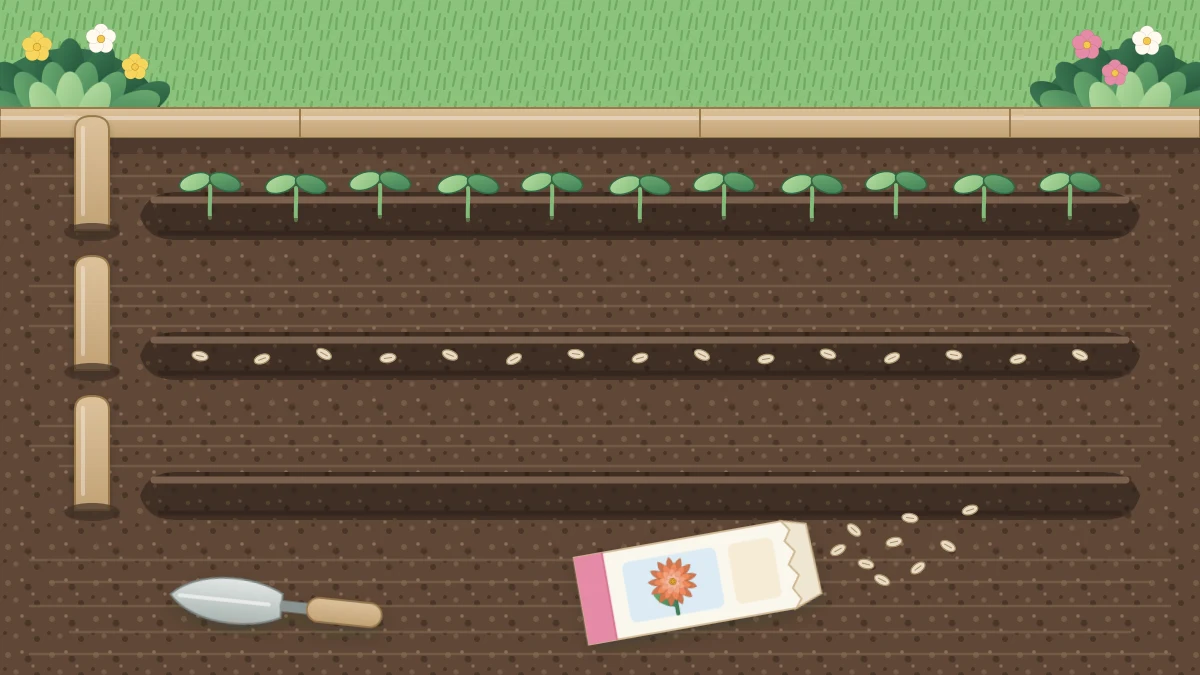
- Make furrows or patches. Draw shallow furrows with a stick or the corner of a hoe, or scratch out a rough circle for a drift. Sowing in straight lines or clear shapes matters later, when you need to tell seedlings from weeds.
- Sow at the right depth. Follow the packet. Where it gives no figure, a common guide is to cover seed to about two to three times its own width. A few flowers need light to germinate; their seed is pressed onto the surface and left uncovered.
- Sow thinly. Place large seeds one by one, a little closer than the final spacing. Pinch small seeds between finger and thumb and sprinkle them sparingly.
- Cover and firm. Draw fine soil back over the seed and press gently with the flat of your hand or the back of the rake, so that the seed sits snugly against the soil.
- Mark the spot. Push a marker in at each end of the row or around the patch, and write the flower and the date on it.
- Water with a gentle spray. Use a watering can with a fine rose or a hose nozzle on its softest setting. A hard stream washes seed out of place.
Tip
Very small seed is easier to sow evenly if you mix it with a spoonful of dry sand first. The pale sand also shows you where you have already sown.
Keep the surface moist until seedlings emerge
This is the stage where most direct sowings fail. A seed that has started to sprout and then dries out will die, and the top layer of soil dries quickly in sun and wind.
Check the seedbed daily by touching the surface. If it feels dry, water lightly with the same gentle spray. In warm, breezy weather that can mean watering more than once in a day; in cool, damp weather you may not need to water at all. Once seedlings are up and growing, begin to water more deeply and less often so the roots follow the moisture down.
Tell seedlings from weeds
Weeds sprout wherever they like; your flowers come up in the pattern you sowed. Look-alike seedlings in a tidy line or inside your marked circle are almost certainly what you planted. Seedlings scattered at random between the rows are weeds.
The first pair of leaves are seed leaves and often look nothing like the adult plant; the true leaves come next. If in doubt, wait a few days before you pull anything.
Thin to the packet spacing
Even careful sowing gives more seedlings than the space can support. When the seedlings have their first true leaves, thin them to the spacing on the packet. Snip the extras at soil level with small scissors instead of pulling them, which can tear the roots of the ones you are keeping.
For more on thinning and on setting out annuals, see University of Maryland Extension. Spacing differs a good deal between varieties; our guide to growing zinnias shows how one popular flower ranges from low edging types to tall cutting types.
Birds, slugs and washouts
A fresh seedbed attracts attention. Three problems are common, and each has a simple physical answer.
- Birds scratch in loose soil and may eat large seeds such as sunflowers. Lay netting or a lightweight row cover over the bed, pinned at the edges, until the seedlings are a few inches (several centimeters) tall.
- Slugs and snails can graze off a row overnight, leaving ragged stumps and silvery trails. Clear boards, stones and debris where they hide near the bed, and pick them off by hand at dusk or after rain.
- Washouts happen when heavy rain or a strong hose stream shifts the soil. If a downpour scatters your seed, wait to see what comes up, then fill the gaps.
Frequently asked questions
How deep should I plant flower seeds?
Use the depth printed on the packet. If none is given, covering the seed to roughly two or three times its own width is a common guide, so large seeds go deeper than small ones. Some flowers need light to sprout and are simply pressed onto the soil surface without any covering.
Why did the flower seeds I sowed not come up?
Several causes are possible. Soil that was too cold, a surface that dried out after sprouting began, seed buried too deeply, old seed, heavy rain and birds or slugs are all common. Check the packet for the usual number of days to sprout, then sow again when conditions are warmer.
Can I just scatter flower seeds on the ground?
Scattering onto unprepared ground rarely works well, because seed needs contact with bare, loose soil and little competition from weeds. You can scatter seed over a weeded, raked patch, rake it in lightly and firm it. Sowing in rows or marked shapes makes weeding easier afterward.