How to Prepare Soil for a Flower Bed
Turn lawn or tired ground into a bed where flowers root well: test the soil's texture and drainage, clear the grass, loosen the ground, mix in compost and let it settle before you plant.

At a glance
What you need
- Spade
- Garden fork
- Rake
- Compost
- Plain cardboard (if smothering grass)
- Hose or string to mark the outline
- Soil test kit from an extension service or lab
Soil work is the one garden job that is hard to redo once roots are in the way, which is why it pays to do it well before planting. If you want to know how to prepare soil for a flower bed, the short version is: learn what you have, clear it, loosen it, add compost and let it settle.
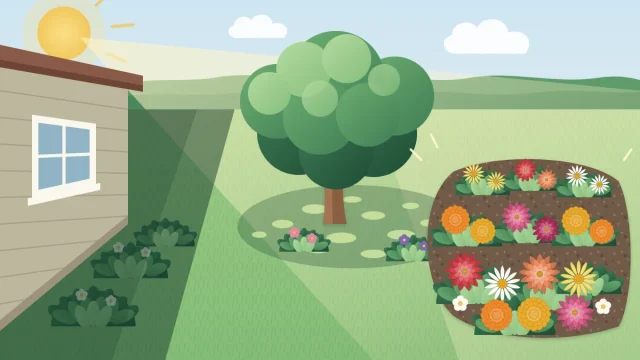
Soils differ widely from region to region, and even from one side of a yard to the other. Begin with a few simple checks instead of a cart full of amendments. Confirm the light before you dig as well, using the method for assessing sunlight in your garden, since a well-made bed in the wrong light is still the wrong bed.
Get to know your soil first
The squeeze test for texture
Take a handful of moist soil from a few inches down and squeeze it. Sandy soil feels gritty and falls apart as soon as you open your hand. Clay soil feels smooth and sticky and holds its shape like modeling clay. Loam, the middle ground, forms a ball that crumbles when you poke it. Most soils lean one way or the other.
The drainage check
Dig a hole about 12 in (30 cm) deep and wide. Fill it with water and let it drain completely, then fill it again and watch. As a rough guide, water that disappears within several hours suggests good drainage, while water still standing the next day points to a drainage problem you will need to plan around.
A soil test
A test through your local extension service or a soil lab reports pH and nutrient levels, things you cannot judge by eye. For an explanation of the kinds of tests and how samples are submitted, see University of Maryland Extension; your own state or regional service will have local instructions.
Clear the grass and weeds
Mark the outline of the bed with a hose or string first. Then choose one of two approaches.
- Lifting sod. Cut the turf into strips with a flat spade, slide the blade under the roots and peel the strips away. It is hard work but the bed is ready at once. Shake off loose soil, and stack the sod upside down to compost.
- Smothering. If you can wait, mow the grass short, cover it with overlapping sheets of plain cardboard, wet the cardboard and top it with several inches of compost. The grass dies underneath over the following months. How long this takes depends on your weather and the vigor of the grass.
Either way, dig out the roots of perennial weeds as you find them. Pieces left behind often resprout.
Good to know
Before you dig a new bed, find out where buried utility lines and irrigation pipes run. Many areas have a free locating service you should contact first. Check locally for the correct number and how much notice is needed.
Loosen the soil
Roots, water and air move more easily through loose soil. Using a spade or garden fork, turn or loosen the bed to roughly a spade’s depth, about 8 to 12 in (20 to 30 cm). Break up large clods and pull out stones, roots and debris as you go.
Do not work soil when it is wet and sticky. Squeeze a handful: if it forms a tight, shiny ball that will not crumble, wait a few days. Digging wet soil, especially clay, presses it into dense lumps that dry hard and can take seasons to recover.
Mix in compost
Spread 2 to 3 in (5 to 8 cm) of compost over the loosened bed and mix it into the top 6 to 8 in (15 to 20 cm). Compost helps both extremes: it helps sandy soil hold water and nutrients, and it opens up clay so water drains and roots can breathe. For more on organic matter and other amendments, see this University of Maryland Extension overview.
Why sand is not the fix for clay
It seems logical to lighten clay by adding sand, but small amounts tend to make matters worse. The fine clay particles fill the spaces between sand grains and the mix can set like a brick. Changing the texture would take a volume of sand far beyond what is practical for a home bed. Organic matter, added now and topped up each year, is the dependable route.
Rake, settle and edge
Rake the surface level, breaking the last clods and leaving the bed slightly higher than the surrounding ground; it will sink as it settles. If you have time, water the bed and let it rest for a week or two before planting. Pull any weed seedlings that appear in the meantime.
Cut a clean edge between bed and lawn with a spade, making a shallow trench a few inches deep. It slows grass from creeping in and makes mowing easier.
Tip
Once the bed is loosened, stay off it. Work from the edges, or lay a board to stand on, so your weight does not pack the soil down again.
If drainage is poor
Compost improves drainage in the top layer, but it cannot fix a site where water sits. If your test hole stayed full, raise the planting level instead. A raised bed 6 to 12 in high, framed or simply mounded into a broad, low berm, lifts roots above the wettest zone. Fill it with a blend of the native soil and compost.
The other honest option is to move the bed, or to choose plants that tolerate damp ground. Few common garden flowers survive long with roots in standing water.
Fertilizer and lime: only by soil test
Fertilizer supplies nutrients; lime raises soil pH and sulfur lowers it. None of them is a routine ingredient. Soils in some regions are naturally acidic, in others alkaline, and adding lime where it is not needed can lock up nutrients that plants require.
Wait for your soil test results and apply only what they recommend, following the product label for amounts. Many beds enriched with compost need little else in the first year.
What comes next
With the bed settled, you are ready for planting your flowers step by step. After planting, a layer of mulch protects the surface you have just worked so hard on; the guide to mulching flower beds covers materials and depth.
Soil preparation is never quite finished. A top-up of compost each year, plus mulch that breaks down slowly, keeps improving the bed long after the digging is done.
Frequently asked questions
How much compost should I add to a new flower bed?
A common approach is to spread a layer about two to three inches deep and mix it into the top several inches of loosened soil. Very sandy or heavy clay soils benefit most. After the first year, a thinner layer spread on the surface each year keeps organic matter topped up.
Can I plant flowers right after preparing the soil?
You can, but letting the bed rest for a week or two is helpful if you have the time. The soil settles, so plants do not end up sitting too high or too low, and the first flush of weed seedlings appears where you can pull it before your flowers go in.
Do I need to add fertilizer or lime when making a flower bed?
Not automatically. Soils vary a great deal by region, and adding lime or fertilizer that is not needed can cause problems. Have the soil tested through a local extension service or lab, apply only what the results recommend, and follow the product label for amounts.