Mulching Flower Beds: What to Use and How Deep
Find out which mulch suits your flower bed, how deep to spread it, when to apply it in your climate, and how to keep it away from stems and crowns so plants stay healthy.
At a glance
What you need
- Mulch of your choice
- Wheelbarrow or bucket
- Rake
- Hand fork or weeding tool
- Gloves
- Watering can or hose
Bare soil does not stay bare for long. Sun bakes it, rain packs it into a crust, and weed seeds sprout in every open patch. A layer of mulch over the surface takes care of much of that with one afternoon’s work.
Mulching flower beds is simple, but the details decide whether it helps or harms: which material you choose, how deep you spread it, and how close you let it sit to the plants. Here is how to get each one right.
What mulch does for a flower bed
- Slows evaporation. Covered soil stays moist longer, so you water less. The guide to watering a flower garden explains how to check moisture under the mulch.
- Suppresses many weeds. Most weed seeds need light to sprout. Mulch blocks it, and the weeds that do appear pull out easily.
- Buffers soil temperature. Soil under mulch stays cooler in hot weather and changes temperature more slowly.
- Protects the surface. Rain and hose water do not splash soil onto leaves or pack the surface into a crust.
- Feeds the soil. Organic mulches break down gradually and add organic matter.
Mulch reduces weeding and watering. It does not end either one, and it will not smother established perennial weeds.
Choosing a mulch material
Use what is available and affordable where you live. Each material behaves a little differently:
| Material | How long it lasts | Where it suits |
|---|---|---|
| Shredded bark or wood chips | Longest of the organic mulches, often more than one season | Perennial beds and borders; around shrubs |
| Compost | Short; largely worked into the soil within a season | Annual and perennial beds where you also want to improve the soil |
| Shredded leaves or leaf mold | About one season | Most flower beds; free if you have trees |
| Pine needles | One season or more | Beds on slopes, since the needles knit together and stay put |
| Straw | About one season | Informal and cutting beds; winter cover |
| Gravel | Permanent | Plants that want sharp drainage and a dry crown |
Shred leaves before using them, because whole leaves can mat into a layer that sheds water. Gravel and other stone mulches hold weeds down but add nothing to the soil.
How deep to spread it
A commonly recommended depth for bark or wood chips is about 2 to 3 in (5 to 8 cm). Fine materials such as compost or shredded leaves pack more tightly, so a thinner layer of 1 to 2 in (2.5 to 5 cm) is usually enough. For a fuller comparison of materials and depths, see the mulch guide from Iowa State University Extension and Outreach.
More is not better. A layer that is too deep can keep the soil soggy, limit the air reaching roots and stop light rain from getting through at all. A layer that is too thin lets light reach weed seeds and dries out quickly.
How to mulch a bed, step by step
- Weed first. Pull or dig every weed, roots included. Mulch spread over growing weeds only hides them briefly.
- Start with moist soil. Water the bed deeply or wait until after a good rain. Mulch holds in whatever moisture is there, and it holds dryness just as well.
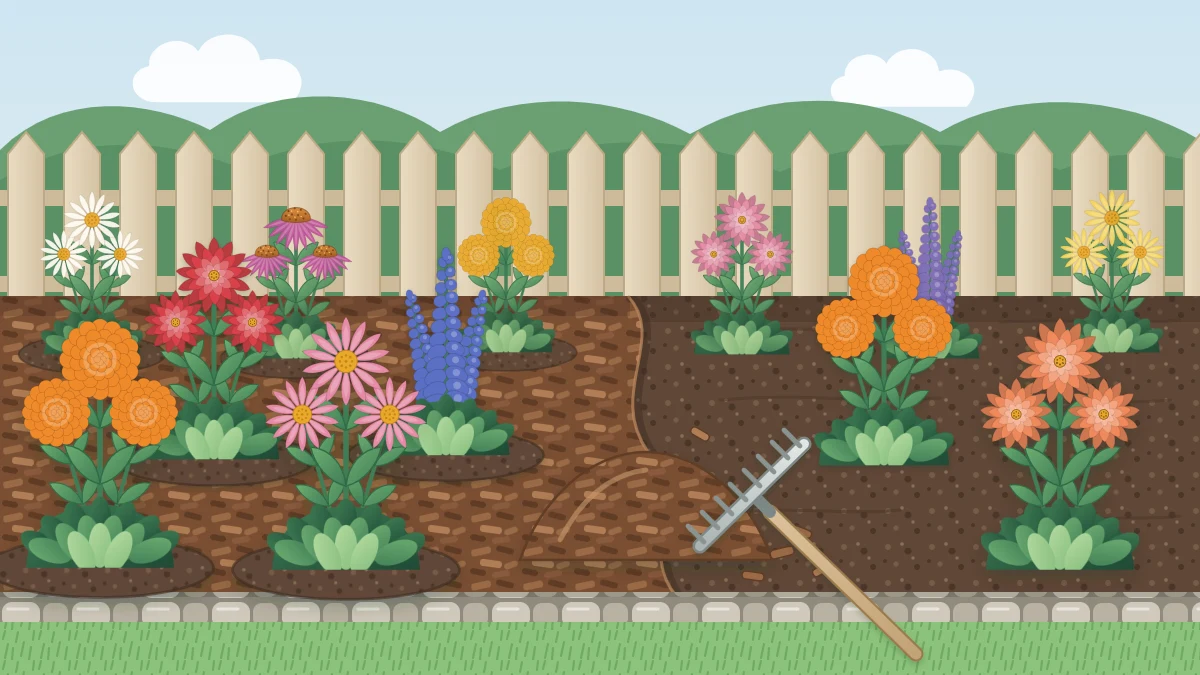
- Tip the mulch out in small heaps. Several piles spaced around the bed are easier to spread than one large one.
- Spread it evenly. Use a rake in open areas and your hands between plants, checking the depth as you go.
- Pull it back from the plants. Leave a ring of open soil 1 to 2 in (2.5 to 5 cm) wide around each stem and crown.
- Tidy the edge. Taper the mulch down toward the lawn or path so it does not spill over.
Good to know
Never pile mulch against stems or over the crown of a perennial. Constant moisture there encourages rot, and a buried crown may struggle to send up shoots. The cone-shaped heaps sometimes seen around plants and tree trunks, known as mulch volcanoes, are a common mistake to avoid.
When to mulch depends on your climate
There is no single right date. Match the timing to conditions where you live:
- Cold-winter climates, growing season. Wait until the soil has warmed in spring and plants are up. Mulch laid on cold, wet soil keeps it cold for longer and slows early growth.
- Cold-winter climates, winter mulch. A loose layer of straw or pine needles goes on after the ground has begun to freeze. Its purpose is to keep the soil steadily cold and limit the freezing and thawing that can heave shallow-rooted plants out of the ground. Applied too early, it can delay plants going dormant. Pull it back gradually as growth resumes.
- Hot-summer and mild-winter climates. Mulch matters most before summer heat arrives, to keep roots cooler and hold moisture. Beds planted in fall for cool-season flowers can be mulched at planting.
Winter mulch is one of several end-of-season jobs covered in the guide to fall cleanup and winter preparation.
Topping up as mulch breaks down
Organic mulch thins as it decays, which is exactly how it improves the soil. Check the depth once or twice a year by pushing a finger down to the soil surface. If the layer has thinned, add only enough to bring it back to the recommended depth instead of a full new layer on top of the old.
If the surface has formed a crust that sheds water, loosen it with a rake or hand fork before adding more.
Three cautions
- Keep fresh wood chips on the surface. They are fine as a top layer, but mixed into the soil they can tie up nitrogen for a time as they decompose. When you plant, scrape the mulch aside, plant, then pull it back.
- Think twice about landscape fabric. Under mulch in a flower bed, fabric makes it hard to plant, divide and move things, and weeds eventually root into the mulch on top of it anyway.
- Mulch is not soil preparation. It works on the surface. Loosening the ground and mixing in compost happen before planting, as described in the guide to preparing soil for a new flower bed.
Frequently asked questions
How deep should mulch be in a flower bed?
A commonly recommended depth is about 2 to 3 inches for shredded bark or wood chips and a little less for fine materials such as compost or shredded leaves. Deeper layers can keep soil too wet and limit air to the roots, while very thin layers let weed seeds sprout.
Should mulch touch the stems of flowers?
No. Leave a small ring of open soil around each stem and keep mulch off the crowns of perennials. Mulch pressed against stems stays damp and can encourage rot, and a buried crown may have trouble sending up new shoots. Spread it between plants, not on top of them.
Do I need to remove old mulch before adding new?
Usually not. Organic mulch breaks down and improves the soil, so you only need to top it up. Check how deep the existing layer is, loosen any crusted surface with a rake, and add just enough fresh material to return to the recommended depth instead of building it higher each year.