How to Divide Perennials Step by Step
Learn the signs that a perennial clump needs splitting, how to time the job for your climate, the lifting and dividing steps, and how to care for the new plants afterward.
At a glance
What you need
- Sharp spade
- One or two garden forks
- Old knife or pruning saw
- Pruners
- Compost
- Watering can or hose
- Mulch
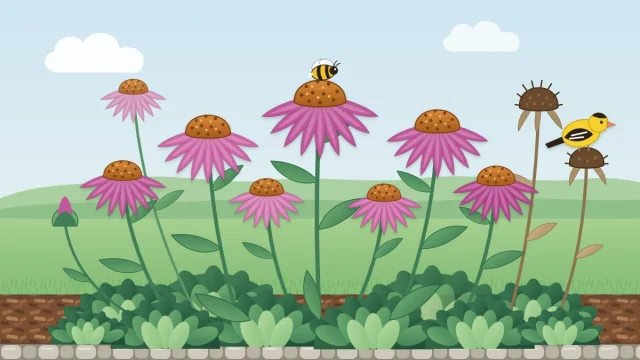
Many perennials grow outward from the center year after year. Eventually the oldest part of the clump runs out of energy, flowers become smaller and the middle goes bare. When you divide perennials at that stage, you swap the tired center for vigorous young sections and end up with extra plants at no cost.
The job looks rough, but most clump-forming perennials recover well as long as you pick mild weather and keep the roots from drying out.
Signs a clump is ready
There is no fixed interval that suits every plant. Some need splitting after a few years, others go a decade untouched. Let the plant tell you:
- A bare, dead or woody patch in the middle, with growth only around the rim.
- Fewer or smaller flowers than in earlier years.
- Stems that flop outward from a crowded crown.
- A clump that has outgrown its space and is pressing on its neighbors.
Poor flowering has other possible causes too, such as shade from a growing tree, so check the light before you blame crowding. A clump that looks healthy and flowers well can be left alone.
When to divide
Timing is a matter of conditions, not dates. Divide when the plant is not in flower and the weather is cool and moist, so the roots can regrow without having to support blooms or cope with heat.
A common guide is to divide spring- and summer-blooming perennials in early fall, and fall-bloomers in spring as new shoots emerge. Adjust it to your climate:
- Cold-winter regions: fall divisions need several weeks to root before the ground freezes. Many gardeners there prefer spring, when a full season of growth lies ahead.
- Hot-summer and mild-winter regions: avoid the heat. The cool season, often fall through late winter, is usually the kinder window.
An overcast day is ideal. For more detail on timing by plant, see University of Illinois Extension, bearing in mind that regional advice reflects local seasons.
Perennials better left alone
Not every perennial should be split. Plants that grow from a single deep taproot, instead of a spreading clump of crowns, resent the disturbance and often fail afterward. Lupines, baptisia, butterfly weed and oriental poppies are familiar examples.
If you are unsure, dig gently beside the plant. Many separate shoots with their own fibrous roots suggest it will divide; one thick central root suggests it is better left in place.
What you need
Gather everything first, because exposed roots dry quickly:
- A sharp spade, and a garden fork if you have one (two forks for large clumps)
- An old knife or pruning saw for dense crowns
- Pruners for cutting back foliage
- Compost for the replanting holes
- A tarp or damp cloth to shade waiting divisions
- Water and mulch
Prepare the new planting spots before you lift anything.
How to divide perennials: the steps
- Water the day before. Moist soil holds together around the roots and a well-watered plant handles the shock better.
- Cut back the foliage. Trim leafy growth to about 6 in (15 cm) so you can see what you are doing and the reduced roots have less to support. In early spring, when shoots are short, skip this.
- Dig around the clump. Push the spade straight down in a circle a few inches outside the outermost stems.
- Lift it. Lever the clump out from several sides and set it on the ground or a tarp. Shake or wash off loose soil if you cannot see the crowns.
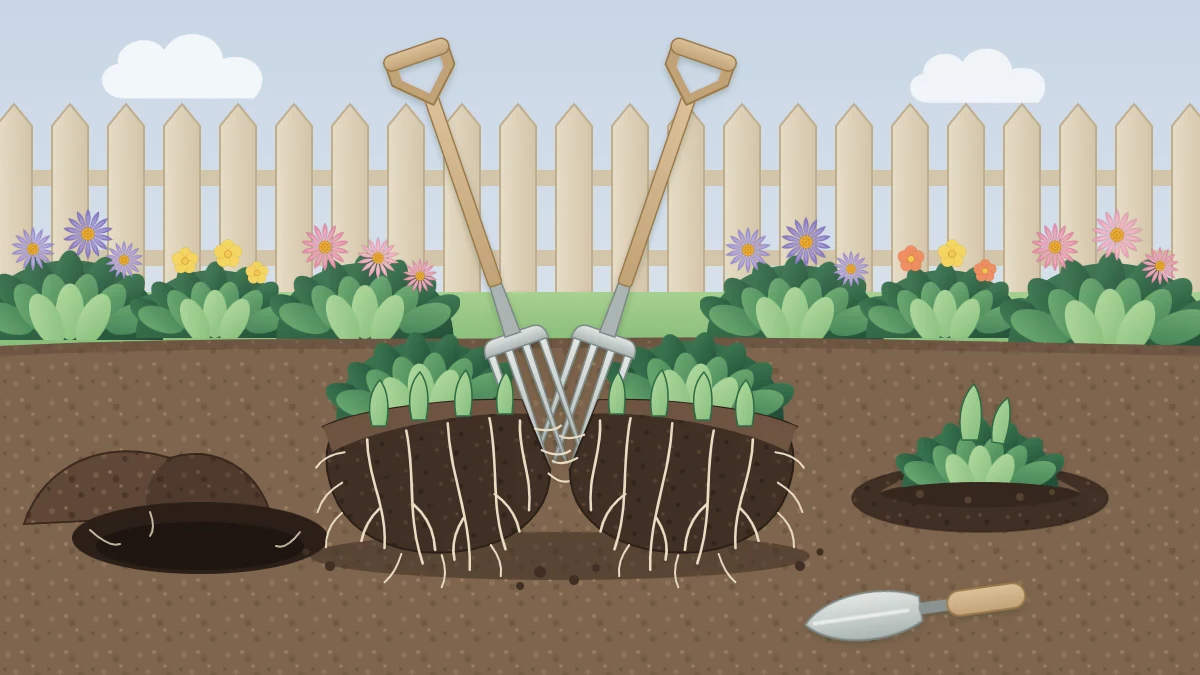
- Split it. For loose clumps, pull sections apart by hand. For tougher ones, slice down with the spade, or push two forks back to back into the middle and pry the handles apart. Dense, fleshy crowns often need a knife.
- Choose the best pieces. Keep sections from the outer edge that have healthy roots and several shoots or buds. Discard the tired, woody center.
- Replant promptly. Set each division at the same depth it grew before, with the crown at the level the tag or the old soil line indicates, and firm the soil around the roots.
- Water in and mulch. Soak the soil to settle it, then spread mulch around, not over, the crown.
Tip
Bigger divisions flower sooner; smaller ones give more plants but take longer to fill out. For a first attempt, splitting a clump into three or four fist-sized or larger pieces is a comfortable middle ground.
Spacing, hole preparation and firming are the same as for any new transplant; the guide to planting flowers step by step covers them in full.
Aftercare
For the first several weeks, treat divisions like new plants. Their root systems are small, so check the soil a few inches down and water whenever it feels dry there. The guide to watering a flower garden explains how to water deeply without overdoing it.
Some wilting in the first days is normal. Temporary shade from a piece of cloth or an upturned basket helps if the sun turns strong. Hold off on fertilizer until you see new growth, then feed only according to a soil test and the product label.
Good to know
In cold-winter climates, fall divisions can be pushed out of the ground as the soil freezes and thaws. A layer of loose mulch applied once the ground has frozen helps keep them in place. Expect lighter flowering in the first season after division.
A good plant to practice on
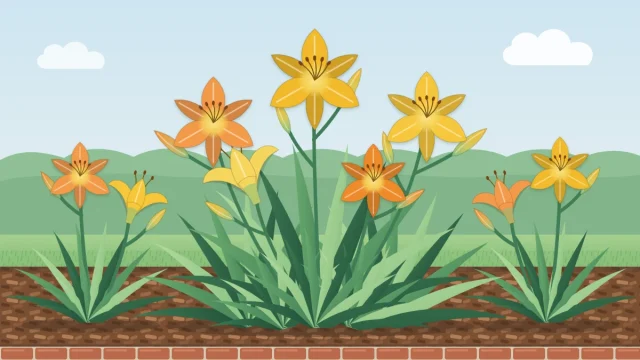
If you have never done this before, begin with something forgiving. Daylilies, hostas and many clump-forming daisies tolerate rough handling and re-establish readily where they are hardy. The guide to growing daylilies describes how their fans of leaves separate, which makes the logic of division easy to see.
Spare divisions can fill gaps elsewhere in the bed, start a new one or go to a neighbor. Pot up any you cannot plant the same day in potting mix and keep them watered in a shaded spot.
Frequently asked questions
How often should perennials be divided?
It depends on the plant and how fast it grows in your conditions. Some fast spreaders benefit after a few years, while others go many years untouched. Watch for a bare middle, fewer flowers or flopping stems, and divide when you see those signs instead of on a set schedule.
Can I divide perennials while they are flowering?
It is better to wait. A plant in bloom is putting its energy into flowers, so it re-roots more slowly and wilts more. If you must move it, cut off the flowers and much of the foliage, keep the divisions large and be attentive with water while they settle.
Which perennials should not be divided?
Plants that grow from a single deep taproot generally resent it. Lupines, baptisia, butterfly weed and oriental poppies are common examples. They are better left in place. If you want more of them, growing new plants from seed is usually the more reliable route.